
From early value modelling to full-scale reimbursement dossiers, MTRC transforms complex MedTech economics into clear evidence that wins pricing and accelerates market access across Europe.
Know your numbers before you cut metal. The moment new medical technology leaves the drawing board, its economic story should already be clear. Early value modelling pinpoints the cost drivers that matter and shows how design tweaks or alternative use‑scenarios can sharpen your value proposition. It also guides your clinical program, ensuring you collect the endpoints (length of stay, complication rates, readmissions) that payers and hospital CFOs care about most, while signaling where your pricing sweet‑spot lies long before you sit down with procurement.
Turn evidence into access when the stakes are highest. As you approach launch, those early models evolve into full cost‑effectiveness and budget‑impact dossiers, the very currency of reimbursement in Europe. Reimbursement and HTA pathways in Belgium, England, the Netherlands, Norway, and Switzerland often demand rigorous health economic analyses as a condition for reimbursement. Meanwhile, solid health economic data arms you for price negotiations and funding decisions with hospital and payer stakeholders. With a seamless line of sight from concept to commercialization, you have the proof points to justify premium pricing, secure favorable reimbursement and HTA outcomes, and win market share faster.
Health economic analysis of a medical device isn’t simple: costing index procedure across many EU countries, handling costs of capital equipment, device replacement and learning curve, incorporating sequential diagnostics are methodologically challenging. MTRC, Europe’s market access specialist, converts that tangle into payer‑ready economic models and publications that clear reimbursement hurdles fast.
Choose Your Perfect Health Economic Model
Three types of models packs: Start-up, Basic, and Comprehensive, so you always have the right health economic ammunition for every stage of your MedTech journey.
| Feature | Start-up | Basic | Comprehensive |
|---|---|---|---|
| Clinical evidence used | None, assumptions | Limited | Limited to good quality data |
| Method | Simplistic form of decision tree, Markov process | Decision tree, Markov process | Decision tree, Markov process |
| Method | Cost, cost-utility analysis | Cost-consequence, cost-utility analysis | Cost-consequence, cost-utility, budget impact analysis |
| Deterministic sensitivity analysis | No | Yes | Yes |
| Probabilistic sensitivity analysis | No | No | Yes |
| CHEERS Statement-compliant reporting | No | No | Yes |
| Ability to present as ISPOR poster | No | Yes | Yes |
| Ability to publish in peer-reviewed journal | No | No | Yes |
| Number of feedback opportunities from client | 0 | 1 | 2 |
| Timelines, weeks | 4 | 5 - 6 | 12 - 16 |
| Use case | Marketing, sales, procurement, investors, clinical stakeholder engagement | Marketing, sales, procurement, investors, clinical stakeholder engagement | Marketing, sales, procurement, investors, clinical stakeholder engagement, reimbursement, HTA |
| Communication | Kick-off, delivery meeting | Kick-off, delivery meeting | Kick-off, delivery meeting, bi-weekly updates by email or TC |
How does it Work?
The key steps in the health economic project are outlined below. During each stage of the project, we validate our approach and data selection with you.
Understanding the scope of work: the purpose (understand the value proposition, publication, use in reimbursement submissions), target audience, a country in scope, the perspective of the analysis (hospital vs health care system), type of analysis (cost-effectiveness vs cost vs budget impact)
Developing the conceptual overview of the model: type of the model (Markov model vs decision tree), health states and conditions, principles of progression of patient or disease
Collection of the data to inform the model: clinical data (transition probabilities, effectiveness, safety), resource use and cost data, quality of life (utility) data
Building the model in MS Excel, quality checks and external validation to determine the performance of the model
Development of the report or publication using ISPOR Good Practice Guidelines
Get Insights from MTRC Free Analytical Reports
Explore free MTRC analytical reports and white papers for in-depth insights into health economic requirements and methodologies for medical technologies in Europe
Explore MTRC research papers:
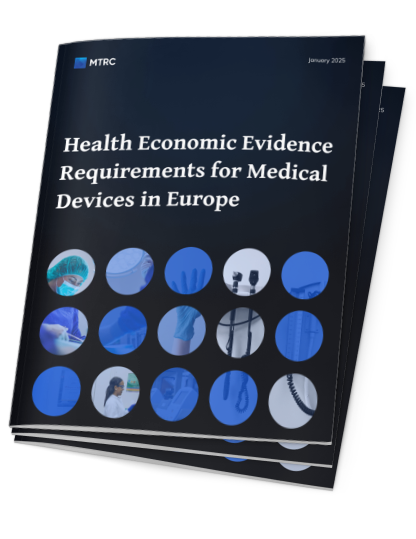
- Health Economic Evidence Requirements for Medical Devices in Europe (Report #13)
- Challenges of Health Economic Evaluations of Medical Devices (Report #10)
- Challenges in Health Economic Evaluations of IVD Tests (Report #17)
- Challenges of HTA and Reimbursement Submissions for Medical Devices (Report #18)
Get in Touch
Contact us to discuss your needs and learn about our services